
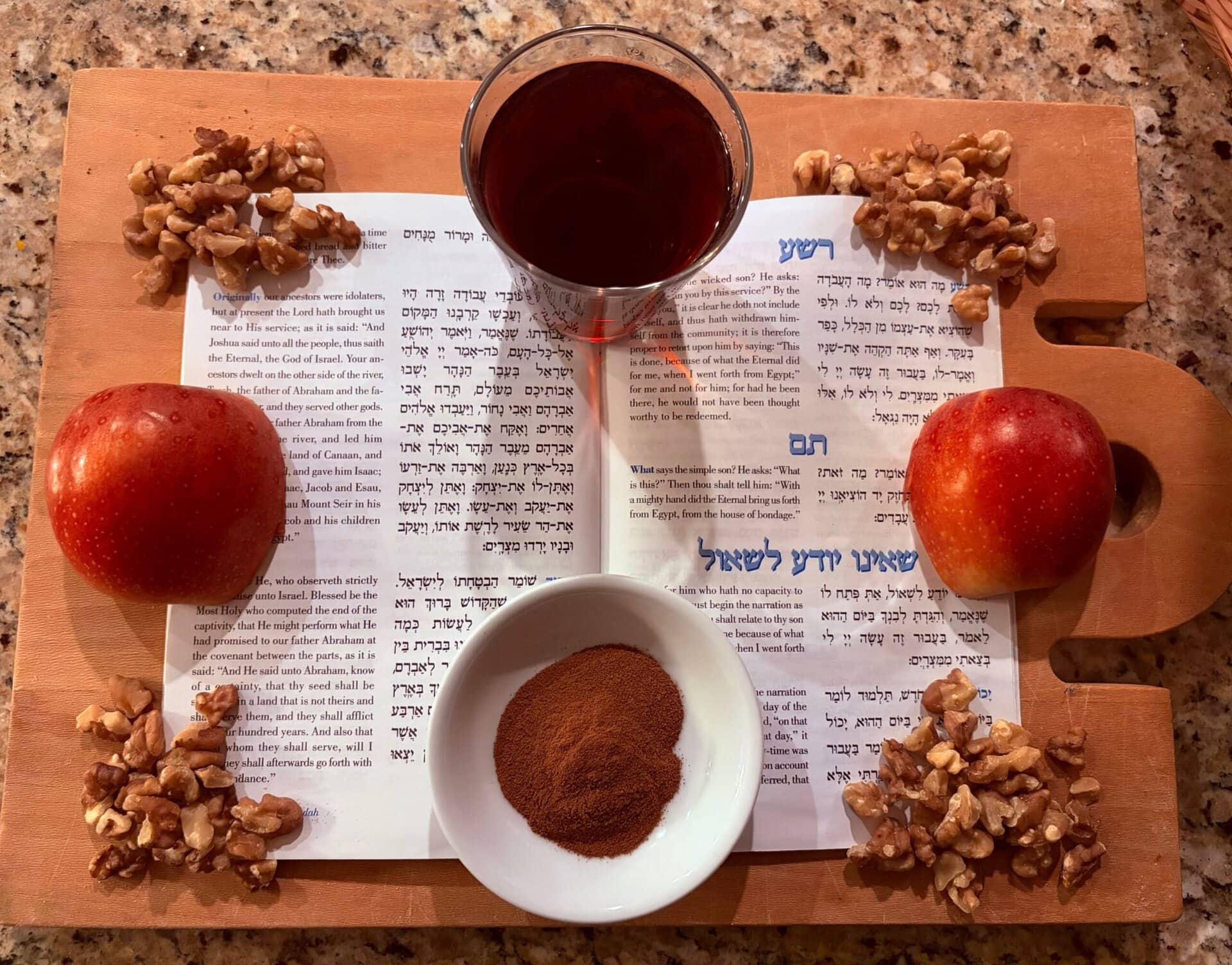
Part One – A Family Recipe
“Take some apples, and maybe some nuts if you feel like it.” my grandmother said, driving a long spoon through the thick mixture. I pressed my fingers to its teal countertop, hoisting my wobbly nine-year-old form up to get a look as she mixed, stout little legs dangling off the table. Seeing that all my limbs were occupied, she coaxed a few sticky spoonfuls of the mixture onto a napkin and slid it towards me with a smile.
“The apple stuff tastes so good every year!” I proclaimed, in the way kids do. “I want to make it at home.”
“I can try to write it down for you later, but I’m not sure exactly what my recipe is, to be honest.” she continued. She gestured to her forehead. “It’s all up here for me. I don’t treat it like an exact science. What makes you ask for the recipe?”
“It’s called charoset.” she smiled. “And I’m glad you like it. Here – If you keep watching me cook it, I can try to explain how I make it to you off the top of my head.”
Throw in some cinnamon and honey – however much you want. Just not too much cinnamon, or it will get too spicy and bitter. It tastes better when it is nice and sweet. Once that is mixed in, you can cover the bowl with plastic wrap and put it in the fridge until the seder begins. But, if your granddaughter gets hungry while the TV is still blaring and the seder plate hasn’t been set, you can sneak the bowl of charoset out of the fridge and let her slather some of those sweet apples onto a matzoh.
A few hours later, I glanced up from the seder table, and met the large and expectant eyes of my grandmother.
“It’s your turn,” my uncle explained calmly.
“Oh!” I stuttered, with a trickle of nervous laughter. I turned to the booklet below me and traced the words with my fingers so that they came alive on my tongue. “Ch…chair-o-set?” I asked.
“I know the spelling looks like ‘chair-o-set’, but it’s pronounced “Haroset.” My grandmother explained, with a forgiving laugh.
“Just ignore the C.” my dad added.
“Okay.” I nodded quickly. “Charoset is a mixture of apples, nuts, and…wine?”
“We’re using grape juice.” My aunt assured me. “Just keep going.”
“…and wine, representing the cement that the Pharaoh forced the Jews to make when they were slaves. We eat the charoset combined with the bitter herbs called Maror to remind us of the bitterness of slavery and the sweetness of the freedom given to us by God.”
Break a piece off a matzo cracker and dip it into the charoset. This is difficult because the broken pieces are prone to crumbling and the thick charoset does not slide onto the cracker easily. Once a few globs of golden charoset have been balanced on your cracker, dip the other side into the bowl of maror.
“Do you want to try the maror?” my uncle asked me.
“Well, we all have to…right? It said to in the book.”
“Yeah, I’m just warning you that it might be a little spicy for you. If you think you can handle it, you can try it, but no pressure.”
“I’ll try it.” I decided.
My grandmother smiled as I chewed the maror and passed the haggadah to my cousin Leona so that she could take her turn reading aloud.
“Our rabbis teach us about four types of people through the story of the Four Children.” Leona read. “The first child is the Wise Child. This child appreciates the seder and wants to understand God’s word better. The second child is the Wicked Child. This child lacks the proper appreciation for the ceremony and scoffs at it. The third child is the simple Child. This child is too young to understand what’s going on – ”
“Why is the one who questions it the ‘wicked child’?” my dad commented. “Like, are we just not supposed to question anything?” He was smiling, but there was an incredulous edge to his voice.
“Well, it’s an old story.” my grandmother said gently.
“Yes, it is.” my dad conceded casually. “No problem. I’m just saying.”
“You make a fair point.” my grandmother acknowledged.
“And why call it the ‘simple child’?” my dad went on, pointing at the illustration of the tiny figure staring wide-eyed at the reader. “It’s a baby! Of course it doesn’t know what’s going on!”
“I always wondered that!” my aunt chuckled. “Poor kid! Jeez!”
Laughter tumbled around the table until it naturally dissolved, and only then did eyes return gently back to the haggadah to continue the ceremony.
Later, on the car ride home, I was the kid who had questions.
“Did that stuff really happen?” I asked, tracing droplets of heady spring rain through the window with my finger.
“Did what happen?” Dad asked.
“Jewish people being at the pyramids and being enslaved and making a hole in the ocean?”
“No.” he said flatly. “I don’t think so. Those are stories.”
“Then why does it say it happened?”
“Because it’s in the Torah, which is like the bible for Judaism.” He said. “So most people who are Jewish believe it.”
“So are grandma and grandpa Jewish?”
“Yeah. I told you that already.”
“But are we Jewish too?”
“No. Um, not really.”
“Then why do we do passover?”
He sighed. “Look, we’re not really Jewish. I mean, we don’t go to synagogue. I don’t really believe in any of that stuff, cause I mean – well, God’s not really real. I mean, that’s just my opinion. Don’t repeat that at school.”
“Why?”
“It’s not good to say that around people who believe in God.”
“Okay, but maybe people at school don’t believe in God.”
“A lot of people do.”
“Then how do you know God’s not real?“
“I mean, there’s no total proof on either side. But we’ve never seen him, it’s never been confirmed, and I like to stick to science. You know, your great grandpa Lev was a physicist. And my dad told me that when he was a kid, he asked his dad – Lev – if God was real, and Lev said ’No. The end.’“
“So then great grandpa Lev wasn’t Jewish?“
“Well, he was really skeptical, and he didn’t believe in God, but he was born to a Jewish family in Hungary. So he was sort of Jewish.“
“Like how we are?“
“Yeah. You and I both are descended from a Jewish family, but we don’t believe in God.“ he said. “And if someone asks if you’re Jewish, just say no.“
***
Part Two – A Formal Recipe
To make the charoset: wash, core, peel, and dice three tart apples. It is important that the apples are not too sweet, given that the sole purpose of the dish is to represent one of many periods of Jewish suffering. Set aside. Chop one and a half cups of walnuts and toast lightly before leaving out to cool. It may take a while before the nuts have fully cooled.
But, after all, if anyone gets hungry before the seder dinner has been served, they should have remembered to eat something beforehand.
As the last few months of ninth grade were dwindling away, I sat on the shining dark green subway bench with my headphones drowning out the gleeful shrieks of friends whom I had grown tired of. I noticed Janine’s clear, kind face next to mine, her mouth moving to form words I couldn’t hear. I removed my headphones.
“I said, ‘you good?’” she repeated.
“Yeah.” I told her, tangling my headphones around my fingers. “Just… well, kind of nervous.”
Satisfied, she gave a simple nod and turned back towards the others.
“Ellie,” she called out to my friend. “What time is the train getting to your house?”
“Around six o’clock.” Ellie answered, eyes stuck to her phone. She dropped her phone into the pocket of her hoodie and clapped her hands, eyes instantly wide and attentive. “Oh, and guys!” she announced. “Don’t eat anything right now, cause you’re gonna have to eat at seder, and my mom is on a very tight schedule so she’s making sure dinner is ready exactly when we get there.”
Quickly, I shoved the bag of chocolate pretzels I’d bought with Janine at the nearby convenience store earlier deep into my backpack.
Still alert, Ellie’s eyes flicked back and forth restlessly for a few seconds before settling on me. “Oh, where’s your change of clothes?” she asked rapidly.
“Change of clothes?”
“Like, what are you wearing?”
“Oh, I just put on my workout clothes this morning. It’s been a while since I did a run, so I…”
“No-” Ellie interrupted anxiously. “I mean, what are you wearing for Passover?”
I hesitated. “…This?”
“Um, it’s a formal event.” she said quietly.
“But…you’re wearing a hoodie.” I countered.
“Yeah, but I have a dress to change into at home.”
“No one told me this.” I said, digging my nails into my thigh to stabilize the nervous beating in my chest. It had never been a formal event at grandma’s house. My grandpa himself often showed up in his customary swim shorts and tank top.
“It was in the group chat.” Ellie said flatly.
I looked at Janine. “It was.” she confirmed.
“I’m sorry.” I said, a nagging red sting growing under my cheeks . What else could I say?
“Look, it’s fine.” Ellie sighed, waving her hand. “Let’s just cross to the platform.”
After about five stops worth of conversation that I hadn’t listened to, Janine tapped me on the shoulder. I removed my headphones.
“It’s okay, I’m nervous too.” she said. “I’ve never done a seder before.”
“Yeah, but Fiona has.” Ellie interrupted. “You have, right?” she said, looking at me. “I mean, aren’t you Jewish?”
“What?”
“You’re Jewish, right?” she asked again.
“Um…” How do I answer this? What had my dad said? “No.” I said.
“Really?” Ellie asked, raising her eyebrows. “I mean, I’ve never seen your mom, but your dad looks, like, insanely Jewish.”
“He looks Jewish?”
“Yes!” she said. “There’s a look. I can usually tell when I meet another Jew. It’s very obvious.”
“I mean, his family is Jewish.” I shrugged.
“His family is…?” she cocked her head, squinting. “So is your dad’s mom Jewish?”
“Um, no, not originally. My dad’s dad is Jewish, and comes from a Jewish family. He had my dad with a Christian woman before remarrying. My grandfather’s current wife is also Jewish, and we do passover with them.”
“Oh, then you’re not Jewish.” she said quickly.
“Okay.” I answered, a tad defensive. “I mean, I didn’t say I was.”
“Yeah, you’re definitely not.” she pressed on. “According to Jewish law, it has to be passed down on the mom’s side. If your dad’s biological mom was Christian, then it doesn’t count.”
“Right.” I said, eager to prove my respect for her and her beliefs. “Yeah, of course.”
What she had said didn’t feel quite accurate. I wasn’t sure that I would call myself Jewish, but saying that I wasn’t Jewish at all felt like ignoring something that was there. I wish I could have told Ellie that I was ‘sort of’ Jewish, like my dad had said – but there didn’t seem to be room for that in her definition.
And anyway, I didn’t want to accidentally intrude on anything that might not be mine.
After showing up to what was apparently a formal event in lazy-looking workout clothes and allegedly ruining my appetite before the seder, I felt like I had already unintentionally disrespected Ellie’s tradition.
In the midst of Ellie and the way that her passover worked, I felt like the simple Child – the little baby who messes up because she doesn’t know what’s going on.
Maybe I was the simple Child because my parents had decided that we wouldn’t fully be Jewish, that we wouldn’t attend synagogue and learn all the tenets of ‘Jewish law’ that Ellie was referencing.
As we stepped off the train and onto the long, lonely platform, a worse possibility hit me: could I have accidentally become the Wicked Child? The person who scorned Passover? Could the casual, laughter-filled tradition of my grandparents have misled me, causing me to accidentally screw up Ellie’s more stringent event?
An indistinct female shout reached our ears, prompting our eyes to wander until we spotted the cheerful, waving outline of Ellie’s mother bathed in the golden wash that the setting sun thrust across the vast parking lot. Lois, as she insisted we call her, welcomed us with a flowing fountain of motherly hospitality as we climbed into her car and wound up and down the gentle green slopes that led to Ellie’s door. “Let me just get back to mixing this charoset.” Lois said as we stepped inside, making a beeline for the kitchen counter. “Sorry – I didn’t actually have time to finish making the whole dinner before your train arrived.” I watched her for a moment as she began to work. Though my grandmother was satisfied to use only her eyeballs and her intuition to create charoset, Lois’s kitchen counter was covered in neatly arranged measuring cups. I took a peak at the cookbook that was spread open on the table and scanned its firmly printed instructions:
Toss the diced apples and toasted nuts with exactly one and a half teaspoons cinnamon, exactly one tablespoon brown sugar, and one half cup Manischewitz Red Wine, and mix for at least thirty minutes. Cover in plastic wrap and place in the fridge to sit.
“Fiona, come on!” Ellie called after me, gesturing to the staircase.
Ignoring the hunger churning in my stomach, I followed the others down to the basement to watch TV until we were allowed to eat, as per Lois’s suggestion. After about two hours, Ellie’s mother summoned us. We walked upstairs to a dining room gleaming with flickering candlelight and what was evidently the household’s special-occasion silverware. As Ellie led the ceremony at a table separate from the one her parents and their family sat at, I was slightly taken aback by the severity of her expression and the lack of laughter and chatter throughout the ceremony that I was so familiar with. But when each of us dipped our matzoh into the charoset, it tasted like so many beloved passovers at my grandmother’s house in the heated blush of Aprils past …and my anxiety began to loosen. Keeping the memory of my grandmother’s Passovers in my head, I felt less and less out of place at Ellie’s seder. I realized that even if my family had not taught me the strict model of Jewishness to which Ellie adhered, they had indeed instilled in me a model of Jewishness – one that allowed me to adapt to Ellie’s seder more smoothly than I initially expected. Whether or not I would really be considered Jewish in the court of public opinion, the years of passovers at my grandparents’ house had formed in me a connection to Passover that transcended religious piety and remained intact whether anyone else chose to accept it or not. I knew that my family felt I belonged at seder even if no one else did. I had not learned to believe in any God, but I had faith – in the love of my family and their belief in me.
Join the conversation!